

Nepal holds the rich of religions and culture significance, from pre-history time period, medieval, to modern periods, becomes a magnet that attract peoples to visit Nepal.
Every place in a unique country has its own significance that holds some historical and cultural significance.
But Nepal, Lockland country in the lap of Himalayas, is different. It not only because of Nepal is home for Great Himalayan Mountain and highest peaks in the world.
The colors, sound, smell and people’s life in Kathmandu is so different from home. Street musician playing a traditional song with a harmonium, bring back my mind to the unknown memories.
Buddhism and Hinduism is a major belief in Nepal and plays a principal role from an ancient time period until present.
Society in Nepal still maintaining their ancient culture and traditions. These all historical, spiritual and culture significances become the magnet that attract peoples to make a journey to Kathmandu Valley.
Kathmandu as the capital city of Nepal. It holds some historical significance for Buddhism and Hinduism.
Nepal became homes of 8 Cultural World Heritage Sites. They are Durbar Square (Kathmandu durbar square, Patan Durbar square and Bhaktapur durbar square), Swayambhunath, Boudhanath and Pashupatinath. Changunarayan and Lumbini
Swayambhunath, Boudhanath and Lumbini, the birthplace of Buddha became a pivot pilgrim and holds many religion significant sites for Buddhist.
While temples at Kathmandu Durbar Square, Changunarayan and Pashupatinath at sacred Bagmati River became a heart of Hindus Pilgrims and holds significant ancient Hindus shrines and temples.
Kathmandu Durbar (palace) Square is important to both Buddhist and Hindu.
It becomes places for Holy ceremonies, rituals, coronations and royal events. These religious sites filled up with many pagoda style-temple and becomes the heart of spiritual seekers
Temples and sacred site in Kathmandu valley from Licchavi, medieval and Malla era contain of fascinating living architecture as examples of God’s supremacy.
The Legend of Kathmandu Valley
The chronicle of Kathmandu valley begins with a legend about how Manjushri, the Bodhisattva, coming down from the north.
Then he splitting the edge of the valley to release huge lake water.
Archeologist discover that the lake drained away around 10.000 years ago. It’s making the valley habitable for the spread of Buddhism.
Human ancestor interaction and how they bring together culture or combine the way of live in past times, bring us to curiosity about the origin of humanity.
Prehistory: Palaeolithic, Mesolithic and Neolithic Era
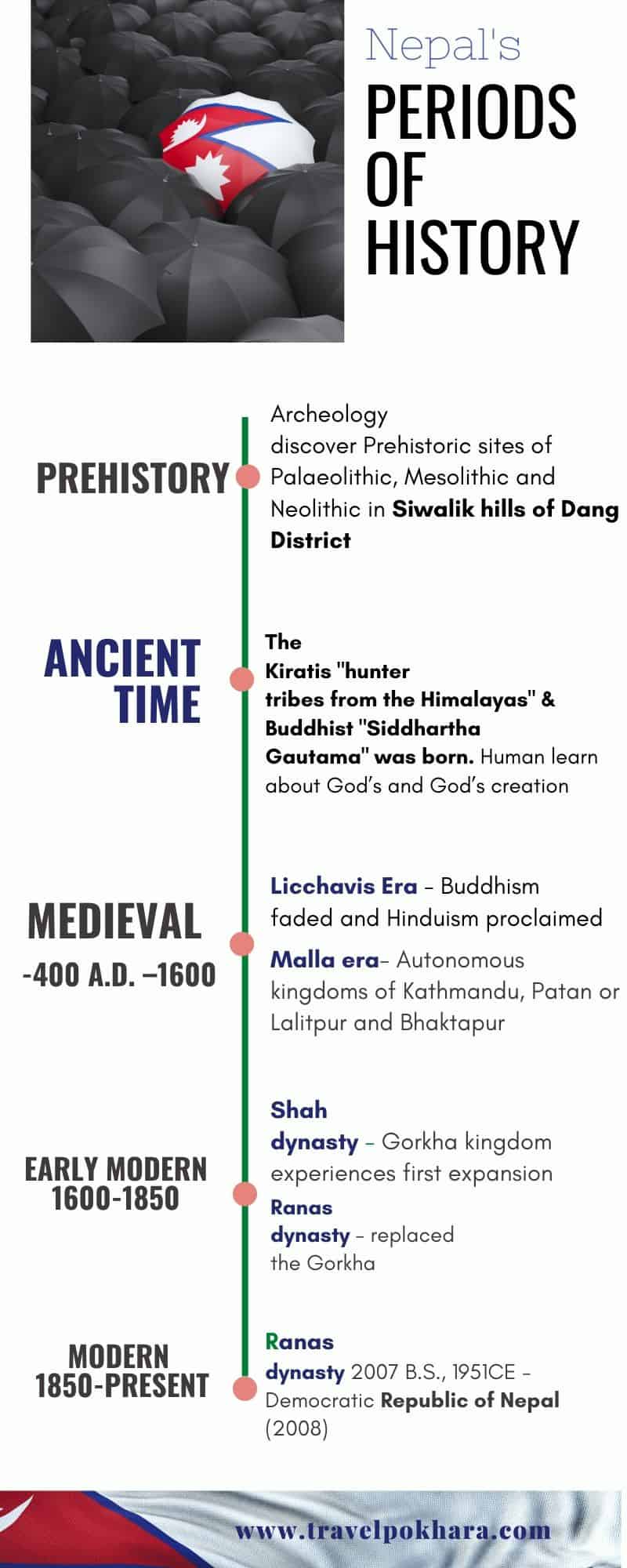
Archeology discover Prehistoric sites of Palaeolithic, Mesolithic and Neolithic.
It’s found in the Siwalik hills of Dang District.
Palaeolithic is the early phase of the Stone Age, and Mesolithic is the middle part of the Stone Age.
Neolithic is the era of progression between behavioral and cultural characteristics changes. These characteristics including the use of wild, indigenous crops and of naturalized animals.
The Sivalik ‘tresses of Shiva’ Hills, also known as Churia Hills. It’s lie down at a mountain range of the outer Himalayas.
In some Sanskrit texts, peoples call these regions Manak Parbat.
The historical sites, Valmiki ashram, also found in ancient time. It shows Sanatana “ancient” Hindu culture in parts of Nepal.
Valmiki Ashram is a small temple, and ashram or hermitage inside Chitwan National Park in Nepal. Valmiki named after the sage Valmiki, the author of epic Ramayana.
He writes his Epic Ramayana in a retreat which locate in these rolling hills many thousands of years ago.
The Kiratis & Buddhist, Ancient Kathmandu
The Kiratis
This ancient time is starting with human learn about God’s and God’s creation, for the first time. Ancient time periods are filling up with foundations and beginnings designed by God. The foundation include art, music and history.
The first tribe that documented in Nepal is Hindu Kiratis. They arriving from the east around the 7th or 8th century BC and moved into the Kathmandu Valley.
These Mongoloid people are the first recognized monarchs of the Kathmandu Valley.

The Kirati people in Sanskrit Kirāta also called as Kirant or Kiranti are an ancient Sino-Tibetan ethnic group. They are indigenous inhabitants of the Eastern Himalayas.
Early Sanskrit literature also mention Kiratas as hunter tribes from the Himalayas.
They are first mentioned in the Yajurveda and in the Atharva-Veda, which dates back to 16th century BC. Kirat means mountain dwellers, societies with the lion’s character.
Yajurveda comes from yajus meaning “worship” and Veda meaning “knowledge”. It’s the Veda of prose mantras for worship rituals.
Atharva Veda comes from atharvāṇas and Veda, meaning “knowledge”. It is the knowledge storehouse of atharvāṇas, the methods for everyday life.
Yajurveda and Atharva-Veda are an ancient Hinduism Scripture, Vedic Sanskrit text.
Mahabharata, the Hindu epic mention King Yalambar, the first of their 29 king, but there is only little documentation about them.
Kirati have inhabited the Kathmandu Valley For more than a millennium. They built their own dynasty. According to Nepalese record, the Kirati tribe ruled from 800 BC – 300 AD (around 1,225 years). The ancestor of Kirat Tribe had worshipped Mother Earth.
Kirati communities in the Kathmandu valley along with native Australians and Austro-Asian. They develop the base for the following society of Newar.
Newar peoples live in Kathmandu Valley and its surrounding areas in Nepal. They are creators of its historic heritage and civilization.

Newars form a linguistic and cultural community of Indo-Aryan and Tibeto-Burman ethnicities. They following Hinduism and Buddhism. Their common language is Newar language.
The Nepali name Kathmandu comes from Kasthamandap, which settled in Durbar Square. In Sanskrit, Kastha means “Wood” and Maṇḍapa means “Pavilion”. The Indigenous Newari term for Kathmandu valley is Yei.
This public pavilion, also known as Maru Satta in Newar language.
The entire structure made from wood and used no iron nails nor supports. According to legends, they got all the logs used to build the pagoda from a single tree.
Buddhist
In the 6th century BC, Prince Siddhartha Gautama was born into the Sakya royal family of Kapilavastu, near Lumbini.
Later Prince Siddhartha Gautama enter a path of meditation and thought. It brought him to enlightenment as the Buddha.
The religion that grew up around him continues to shape the face of Asia.
Around the 2nd century BC, the great Indian Buddhist emperor Ashoka visited Lumbini and set up a pillar at the birthplace of the Buddha.
Popular myth describes how he then visited the Kathmandu Valley and set up four stupas (pagodas) around Patan. But there is no evidence that he made it there in person.
The Nepal’s Medieval Era to Modern period time
Licchavis Era
This fascinating period of knights, castles, monarchs and queens has many outstanding examples of God’s supremacy.
Buddhism faded and Hinduism proclaimed itself with the arrival from northern India of the Licchavis.
In AD 300 they conquered the Kiratis, who immigrated in the east. Later they are the forefathers of today’s Rai and Limbu people.
Between the 4th and 8th centuries, the Licchavis created a golden age of cultural wisdom. It’s presumed that the initial stupas at Chabahil, Boudhanath and Swayambhunath date from the Licchavi era. They built the valley’s most ancient sacred sites, both Hindu and Buddhist.
The chaityas (stupas) and shrines of this era still exist at the Changu Narayan Temple, North of Bhaktapur, and in the backstreets of Kathmandu old town.
The strategic position of Kathmandu make them prosper from trade between India and China (Trans Himalaya)
Malla era
After Licchavis era, came the Malla era 13th-18th. They considered the Malla for bringing Hinduism to the region.
Kathmandu was an autonomous city within the valley. But in the 14th century they unified the valley under the rule of the Malla king of Bhaktapur.
In the 15th century, it had split once more, this time into the three autonomous kingdoms of Kathmandu, Patan or Lalitpur and Bhaktapur.
These palaces compound with a temple-filled square, or Durbar square. Each competed with the others for domination of the profitable trans-Himalayan trade. Its market route to Tibet.
Shah dynasty – Ranas dynasty – Democracy
Conflict between the three city-states brought to a series of wars.
It moved each state damaged and weak to the King Prithvi Narayan Shah’s invasion, King of Gorkha.
The Malla era ended after their failure in the battle of Kathmandu in the year 1768 against the Gorkha kingdom in the hills 80 miles to the west.
They occupied the valley in the mid of18th century.
The Ranas then replaced the Gorkha in 1846. The region was under monarchy government until the year 2008. After that, the monarchy wiped out, and they formed a republic replacing the former monarchy.
Journey to the ancient palaces: Kathmandu Durbar Square

Kathmandu known as the city of temples, because it’s become a home of many temples from Medieval period time.
They belief that Kathmandu is blessed by Living Goddess Kumari.
She is a little Buddhist girl who chosen through a high selective process. They believe her as the embodiment of the powerful Hindu Goddess Taleju or Hindu mother goddess.
The Living Goddess Kumari residence lies nearby The Durbar (palace) Square.
Besides the Living Goddess, Kathmandu also worship the incarnations of Ganesh and Bhairab. They believe Bhairab to be an incarnation of Lord Shiva in the form of a tiger. They also call him is also Aju Deu, meaning a grandfather god “a guardian figure”.
Ganesh or Ganesha is the Lord of Good Fortune who provides prosperity, fortune and success. He is the Lord of Beginnings and the Remover of Obstacles of both material and spiritual kinds.
In Indra Jatra festivals, the chariot of the Living Goddess Kumari along with chariots of Bhairab, and Shiva are shown to the public.
These festival is one festival that become spotlight with a procession of masked dancers. Often, spirits of gods are Possesse the masked dancers.
The endless processions and ceremonial events enrich the city life. In these festivals, many peoples take to the streets to celebrate and seek pleasure in spiritual ceremonials.
The Kathmandu Durbar (palace) Square, built in Malla Era, a UNESCO World Heritage Site lies in the heart of the Kathmandu city. Now it’s become museum.
Durbar Square means “palace” or “a court held by a prince”. Kathmandu Durbar Square is a religious site for spiritual seekers. These old-palace is an important site for Buddhist and Hindu rituals, holy ceremonies, coronations and royal events.
The inner complex is the old royal palace. The kings of the Shah and Malla Dynasty live in these old royal palaces, called a Hanuman Dhoka Palace Complex. Now, the palaces turn into museums.

The outer complex of Durbar Square accompanied by a number of pagoda style-temples built in the Newari architectural style.
It’s crafted in superb wood and metal craftsmanship. There are also fountains, ancient statues, small ponds, and a series of courtyards. The large walls enclose these an unroofed area.
Temples in Kathmandu Durbar Square
The following are several temples in Kathmandu Durbar Square:
- Jagannath Temple
Jagannath god is a form of Vishnu. this is the oldest structure in Durbar Square and famous because they have the various erotic sculptures on its roof.
Ancient architectural texts said that the carving of such figures on temples as a way of protection of lightning and other natural calamities
The erotic carvings were thus a part of this realistic illustration. Some say they placed the erotic sculptures on the temple because temple symbolize heaven on earth, and heaven is the place of sensual delight and the abode of Apsaras.

- Kotilingeshwara Mahadev. This is a stone temple of Lord Shiva
- Mahendreswara Temple
They believe the Lord Sri Mahadeshwara to be the embodiment of Lord Shiva. Sri Male Mahadeshwara performed several miracles to save the people and saints.
- Taleju Temple
This is the largest and most important temple. The temple is not open to the public and Hindus.
They restrict the admission. Hindus can only visit once a year on the ninth day of the Dashain festival. Often, Hindus perform animal sacrifices around the area.
They built the Kathmandu Taleju temple simulate on the shape of yantra. Yantra is a mystical diagram from the Tantric traditions that have magical power.
There are 12 miniature versions of the temple inside Taleju temple, that encircle the principal building.
Four more temples built higher up just below the main temple. The stone lions guarding the temple and it embellish the four primary gates.
The golden statues describe the ten-armed Goddess along with shrines to both Taleju Bhawani and Nepal’s Living Goddess Kumari, inside the main Taleju temple.
Taleju Bhawani is Hindu Goddess from the south of India, but later became the family deity of the Malla Kings. Kumari is regard as the human manifestation of the Goddess Taleju.
Taleju Bhawani made a special appearance as a bee when the temple was opened. They do not allow it for any building to be built taller than the Taleju building.
- Mahadeva Temple.
They built this temple to worship Lord Mahadev. Mahadev also known as the great god, Lord of the Lord. He is one of the principal deities of Hinduism.
- Shiva Parvati Temple.
The Hindu trinity includes Brahma, Vishnu and Shiva. They believed that Lord Shiva was the Destroyer. In Shaivism tradition, Shiva is one of the supreme beings who creates guards and changes the universe.
While Parvati (Sati) is the Hindu goddess of love, fertility, beauty, marriage, children, and devotion. She is a source of divine strength and power. Parvati is the consort of Shiva.
- Maru Ganesh
This temple belongs to Lord Ganesha, also known as Vinayak. Hindus worship Lord Ganesha as gods of fortune. This temple houses one of the four original Ganesh temples from the Kathmandu valley.
- Bhagwati Temple
Goddess Bhagwati is an incarnation of Goddess Parvati, the equal harmonious partner of Lord Shiva.
- Saraswati temple
Saraswati is the Hindu goddess of knowledge, art, music, wisdom, and learning. She is a part of the Tridevi of Saraswati, Lakshmi, and Parvati.
Tridevi help the trinity of Brahma, Vishnu, and Shiva to create, protect and regenerate the Universe.
- Octagonal Krishna Temple
Krishna is a major deity in Hinduism. He is worshipped as the eighth avatar of the god Vishnu and also as the supreme God. He is the god of compassion, love and tenderness.
This temple built in the shikara style means mountain peak. It’s North Indian temple architecture.
- Jagannath Temple
Jagannath Temple is a Hindu temple dedicated to Jagannath, a form of Vishnu.
- Kal Bhairav
Hindus worship Kal Bhairav. He is Hindu Tantric deity. In Shaivism, he is a fierce manifestation of Shiva.
- Kumari Bahal Temple
This is Newari temple of the Living Goddess Kumari. The most peculiar and revered sites at the southern edge of Kathmandu Durbar Square. It is houses the Living God Kumari Devi.
Journey to ancient palace: Patan (Lalitpur) Durbar Square

Now, Lalitpur is the third largest Metropolitan City of Nepal after Kathmandu and Pokhara. It is located in the south-central part of Kathmandu Valley Lalitpur is Patan in the history also known as Manigal.
Lalitpur best known for its rich cultural heritage and tradition of fine ancient art and metallic and stone crafts. It known as a city of festival and feast.
Patan Durbar Square are UNESCO World Heritage Site, one of the three Durbar Squares in the Kathmandu Valley. It is located at the center of the city of Lalitpur.
One of its attraction is the ancient royal palace where the Malla Kings of Lalitpur lived.
The Durbar Square is a wonder of Newar architecture. Newar architecture is an indigenous style of architecture used by the Newari people in the Kathmandu valley in Nepal.
The style is noticeable by remarkable brick work and a unique style of wood carving that found outside Nepal. The square floor is a cover with tiles of red bricks.
They place the main temples of Durbar Square on the reverse side of the western face of the palace. The entry door of the temples faces east, towards the palace. They place Bell in the alignment beside the main temples.
The Patan Durbar Square also holds old Newari residential houses and other temples and structures in and around Patan Durbar Square.
Patan/Lalitpur is one of the oldest Buddhist cities.
Patan Durbar Square has 136 “bahals” or courtyards and 55 main temples. These are a center of both Hinduism and Buddhism.
Precious buildings at Patan Durbar Square
The following are precious buildings at Patan Durbar Square:
- Krishna Mandir
This is the most important temple in Patan Durbar Square. It built in the local variety of Shikhara style in Malla era.
The carvings in first-floor pillar narrate the story of the Mahabharata, while the visual carvings in second floor tell a story from Ramayana.
The King saw Lord Krishna and his consort Srimati Radha standing in front of the royal palace at one night. After that King order a temple to built on the same spot.
Krishna Mandir have 21 golden pinnacles in the temple and three stories below the pinnacles. The first floor holds the major shrine of Lord Krishna with shrines of Rukmini and Radha. They devote the second floor to Lord Shiva while the third to a bodhisattva who embodies the compassion of all Buddhas, Lokeshwor or Avalokiteshvara.

the most important temple in Patan Durbar Square
- Bhimsen Temple
Bhimsen (Bhin: dya) is a superb personality in Mahabharata. He was brave and strong. In Newar Communities, they worship him as a god of trade and business. They restrict tourists to go inside the temple.
- Vishwanath Temple
They devote Vishwanath Temple to God Shiva. Erotic carvings similar to imagination widespread in Shiva temples decorating the roof supports.
Inside the temple enshrine a stone linga and two stone elephants in the front door protect the temple. The temple is the carving of Shiva’s vehicle, a sacred bull calf, Nandi.
- Taleju Bhawani Temple
Taleju Bhawani was the intimate god of the Malla kings. These temples have a five-storey temple with triple-roofs.
Three main courtyards
The palace have three main courtyards that have impressive temples, historical places and religious shrines with ancient Newari architecture.
They are Mul Chowk, Sundari Chowk and Keshav Narayan Chowk.
Mul Chowk is the main courtyard. They locate vidya Temple at its center while Taleju temples stand around the courtyard.
They design Mul Chowk with sunken tank known as Tusha Hiti. The entry door of the chowk protect by the stone statues of Hanuman, Ganesh and Nara Singha, man-lion form of Vishnu.
Keshav Narayan Chowk is inside the Patan Museum while Sundari Chowk is to the south of the Mul Chowk.
You can see various local shops selling typical Newari cuisine once you enter the Sundari chowk. Typical Newari cuisine made up of kachela, yomari, chhoila, black beans, beaten rice, and vegetables along with the newari drink made from rice called chhyang.
Sundari chowk is famous for the night life.
Journey to ancient palace: Bhaktapur Durbar Square

Bhaktapur has the best-preserved palace courtyards and old city center in Nepal.
They register it as a Cultural World Heritage Site by UNESCO for its rich temples and culture, and also because of wood, metal and stone artworks.
Now, Bhaktapur durbar square is a national gallery. Peoples restrict to enter the temple and take a picture of the living goddess.
There are Golden Gate which leads into Mulchok Court, which is home to the Taleju Temple dedicated to the goddess Taleju Bhawani. These includes shrines to both the Taleju Bhawani and Kumari.
Spectacular Newari architecture enriched the Bhaktabur Durbar square
Major attraction of Bhaktabur Dubar Square
The following are major attraction of Bhaktabur Dubar Square:
- The Palace of Fifty-five Windows (55 window palace-Nge Nyapa Jhya Laaykoo)
- Vatsala Temple
A stone temple with magnificent carvings dedicated to goddess Vatsala Devi. There are silver bell known to local society as “the bell of barking dogs”
It because dogs in the surrounding barked and howled when the bell rung. King Ranjit Malla hung the colossal bell to sound the daily curfew. They rang the bell when they worshipped goddess Taleju every morning.
The Temple being demolished by the 2015 Gorkha earthquake, but the bell remains intact.
- The most magnificent Statue of King Bhupatindra Malla
- Nyatapola “five stories” Temple
“Pancha Tale Mandira.” is the other name of this temple. This temple is the symbolic of five basic elements. They dedicate this temple to the goddess Shiddhilaxmi. This temple is open for the public during Dashain, once a year.
Nyatapola temple is the highest and biggest pagoda of Nepal with architectural artistic beauty and perfection. The temple has a foundation that made wider than its base.
This temple protects by statues that lined up on the two sides of the staircase. They build the statues as protector of the living goddess.

- Bhairava Nath Temple. They devote the Bhairava Nath Temple to the most fierce manifestation of Lord Shiva, Bhairava.
- Golden Gate “Lun Dhwākhā”
this is the most beautiful and famous Golden gate of Bhaktapur. Figure of the Hindu goddess Kali, Garuda (mythical griffin) and two heavenly nymphs place over the door.
marvelous intricacy monsters and other Hindu mythical creatures embellishes the door. The most lovely piece of art decorate the Golden Gate.
- The magnificent and beautiful Lion’s Gate
This gate built by artisans whose their hands have been broke off upon completion by the envious Bhadgoun king, so that no more of such masterpieces could rebuild.
- Mini Pashupati Temple
Bhadgoan king was a dream then built the holy god Shiva temple, Mini Pashupatinath Temple, right in front of the palace
How to get to the Ancient Palace (Durbar) Square
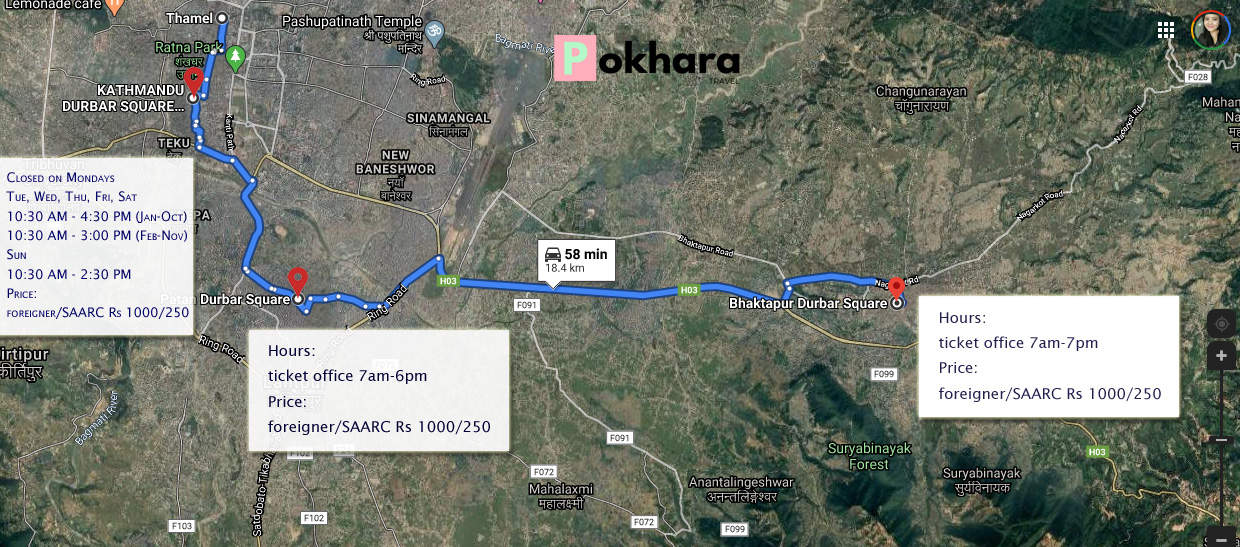
Nepal only have one international airport in Kathmandu that handle intercontinental flights. The name of the airport is Tribhuvan International Airport. That’s why Kathmandu known as the Gateway to the Nepalese Himalayas.
To start your journey to ancient Nepal, you need to take flight from your country to Kathmandu. From here, you can start your journey to the closest Durbar Square in Kathmandu, Kathmandu Durbar Square.
Nowadays, tourist Stay at Thamel, backpacker tourist center in Kathmandu.
It takes 10 minutes driving from Thamel to Kathmandu Durbar Square or 20 minutes walking. The distance from Thamel to Kathmandu Durbar Square is around 1.6 km.
Thamel to Patan Durbar Square at Lalitpur takes around 20-30 minutes driving. The distance is around 7 km.
The farthest Durbar Square from Kathmandu is Bhaktapur Durbar Square. The distance from Thamel is around 16 km. It takes 37-45 minutes driving.
Recommended Cultural Tour in Kathmandu Valley
It takes minimum 5 days to embrace the journey of ancient palace in Kathamndu valley. Longer is better, you can visit other incredible Cultural World Heritage Sites, Boudhanath and Pashupatinath.
If you wish, you can go to my recommended page here. The page will be a link to local agencies that provide cultural tours with driver and guides. You also can ask a recommendation for Hotels and discuss your custom trips to Nepal.
My Last Thought
Kathmandu is worth visiting due to the historical, spiritual and culture significances.
Kathmandu durbar square, Patan Durbar square and Bhaktapur durbar square are three old palaces that have important role in trans-himalayas trade.
Durbar (palace) Square is important to both Buddhist and Hindu.
It becomes places for Holy ceremonies, rituals, coronations and royal events. These religious sites filled up with many pagoda style-temple and becomes the heart of spiritual seekers
The Temples being demolished by the 2015 Gorkha earthquake and now (2020) it’s in the progress of restoration, even though the greatness of the palaces still intake.
In order to provide free information to readers and to keep this website with minimal advertisements, blog posts may contain affiliate links. If you click on a link within the blog and make a purchase, I will earn a small referral fee at no extra cost to you. I only recommend products and companies that I use personally. Thanks in advance for your support! travelpokhara.com is a participant in the Amazon Services LLC Associates Program, an affiliate advertising program designed to provide a means for sites to earn advertising fees.
Recent Posts
Krishiv Homestay: A Unique and Unforgettable Travel Experience
Krishiv Homestay: A Unique and Unforgettable Travel Experience Looking for a unique and unforgettable travel experience? Look no further than Krishiv Homestay in Bhaktapur, Nepal. This family-run...
A Profound Journey to Lumbini - Exploring the Birthplace of Lord Buddha
Unraveling the Serenity of My Lumbini Pilgrimage I'm excited to share my Lumbini pilgrimage experience with you. Nestled in the foothills of the Himalayas, Lumbini is a sacred destination revered as...